

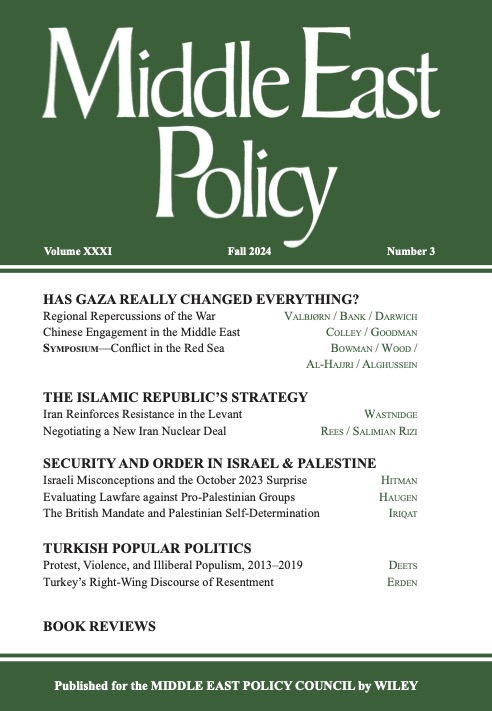
Middle East Policy
Volume XXXI, Issue 3
Fall 2024
This issue, the journal’s 161st, explores the effects of the Gaza war, the many elements of security and order in Israel and Palestine, Iran's regional strategy, Turkish domestic politics, and more.
Has Gaza Really Changed Everything?
Forward to the Past? Regional Repercussions of the Gaza War
The Gaza war between Israel and Hamas marks the end of the long decade after the Arab uprisings. In this paper, we explore how the conflict has altered the regional political landscape ...
Security in Neutrality: Chinese Engagement In the Middle East and the Red Sea Crisis
China's interests have expanded rapidly in the Middle East since the turn of the century, and it is now the leading trade partner for many states in the region. The unrest sparked ...
Conflict in the Red Sea: The Role of Great-Power Actors
The following is an edited transcript of the 116th in a series of Capitol Hill conferences convened by the Middle East Policy Council. The event took place on July 25, 2024, in ...
The Islamic Republic's Strategy
Reinforcing the Resistance: Iran and the Levant in a Multipolar Middle East
Hamas's al-Aqsa Flood operation, Israel's brutal response, and the regional escalation of the conflict, including Iran's and Israel's unprecedented strikes on each other's territory, mark a critical juncture for the Middle East. ...
Negotiating the Restoration Of the Iran Nuclear Deal
There have been protracted negotiations in Vienna to revive the Joint Comprehensive Plan of Action (JCPOA), or nuclear deal, that Iran signed in 2015 but was suspended by the withdrawal of the ...
Security and Order in Israel & Palestine
What Went Wrong? Israeli Misconceptions And the October 2023 Surprise
This study examines Israel's failure to prevent Black October, the Hamas invasion that killed more than 1,100 people and sparked the Gaza war. The article synthesizes literatures of security and intelligence to ...
Evaluating the Practice of Lawfare Against Pro-Palestinian Groups
For nearly 20 years, nongovernmental organizations backing the Palestinian cause have promoted both “differentiation” and the better-known strategy of boycott, divestment, and sanctions (BDS). Differentiation is the practice of distinguishing between Israel ...
Legacy of the British Mandate: Eliminating The Palestinian Right to Self-Determination
In February 2024, Prime Minister Benjamin Netanyahu issued a plan for the “postwar” Gaza Strip that envisions Israel's military as unilaterally and indefinitely patrolling the enclave while an unnamed third party runs ...
Turkish Popular Politics
Protest, Violence, and Illiberal Populism In Turkey, 2013–2019: A Network Perspective
This article argues protest and violence between 2013 and 2019 both strengthened Turkey's competitive authoritarian regime in the short term and significantly weakened it over time. Crises in liberal democracy create opportunities ...
Turkey’s Right-Wing Discourse of Resentment
Right-wing politics has increased its potency around the world, especially in Turkey, which has experienced a two-decade reign of President Recep Tayyip Erdoğan and his Justice and Development Party (AKP). One of ...
Book Reviews
Degrade and Destroy: The Inside Story of the War Against the Islamic State, from Barack Obama to Donald Trump
Book Author: Michael R. Gordon Reviewer: A.R. Joyce Reviewer Title: Editor, Middle East Policy. Publishing Info: Picador, 2024. […]
The World Powers and Iran: Before, During, and After the Nuclear Deal
Book Author: Banafsheh Keynoush Reviewer: Mahmood Monshipouri Reviewer Title: Professor of international relations, San Francisco State University. Publishing […]
A Sultanate that Endures: Oman in the World from Qaboos bin Sa’id to Haitham bin Tariq
Book Author: Joseph A. Kéchichian Reviewer: Richard J. Schmierer Reviewer Title: Former president and chairman of the board, […]